

When and How to Trim Your Beard with Scissors – A Complete Guide and Practical Tips

Growing a beard is a stylistic choice and a patient craft. Done well, it can enhance your facial features; sloppily trimmed, it can instantly detract from your overall appearance. Compared to electric clippers or a razor, trimming your beard with scissors (using barber shears or specialized beard trimmers) is better suited for fine-tuning and retaining a natural look without looking forced.
So the question is: when should you use scissors? What precautions should you take? I’ve tried many methods myself, and while I’ve made my share of mistakes, I’ve found that with the right tools and timing, you can achieve near-salon-quality results at home. Let’s break it down step by step.
1. When should you use scissors to trim your beard?
In fact, scissors are not a panacea, but rather a “master of details”. Scissors are most suitable for the following situations:
long,your beard is still young and growing, it’s easy to cut unevenly with scissors. Once your beard is a
few millimeters long and its direction and layers are clearly visible, the precision advantage of scissors will be realized.
Need to do detailed or contouring
such as cheek lines, jaw lines, and lip edges. Scissors are more flexible than clippers and can preserve the natural feel of the hair tips, without the mechanical feeling of clippers.
want a natural “end” look, and
prefer a softer, less symmetrical, yet neat style, you can use scissors to trim it a bit. A little point-cutting can make your beard look more layered.
Repair the “hard edges” of electric clippers.
Occasionally, clippers will leave a “step feeling” or break hairs. Scissors can remedy this and make your beard smooth again.
, trimming is requiredRegular maintenance
For medium-length beards requires trimming every 2-4 weeks, while those with a stubble style can use a combination of clippers and scissors more frequently.
- Conclusion in one sentence: Scissors are suitable for making details and trimming natural lines, rather than being a one-size-fits-all tool for quickly shortening.
How to trim your beard with scissors: tools and steps
Tool List
- A pair of sharp beard scissors (with smooth, non-picking blades)
- Beard comb or fine-tooth comb
- Towel (hot towel optional)
- Mirror and plentyMirror + plenty of light
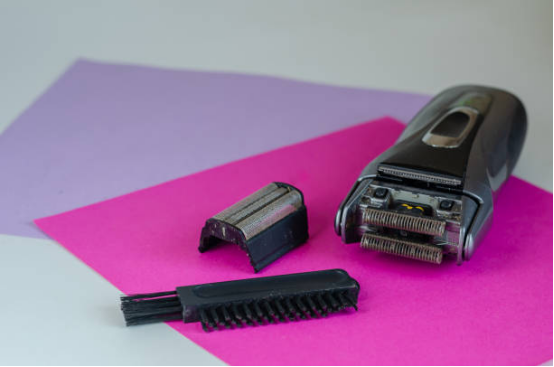
- Electric foil shaver for necklines or cleaner finishes
Steps
Wash and soften
your beard. Wash your face or beard first, and apply a hot towel for optimal results. Be careful not to trim your beard while it’s completely damp, as wet hair will stretch, and once it dries, you might be surprised to find you’ve cut too much. I usually wait until my beard is half dry before I start.
observe.Comb and observe
the hair. Comb it in the same direction as the hair, then gently comb it in the opposite direction to make the hair stand up. This way you can see the location of stray hairs and protruding hairs at a glance.
Determine the length and contour.
Think about your cheek, jaw, and neck lines beforehand. Otherwise, if you hesitate halfway through cutting, it’s easy to end up with asymmetrical hair. Tip: Use a comb or your fingers as a “block” to determine the general outlines first.
Starta side trim,
start with one side and then the other. Trim only the protruding part of the comb teeth, using small, gentle movements. Slow is better than fast; this is really important.
chin.Comb your beard down along your lip line and chin
, trimming any hair that extends beyond your lip line to create a clean, fresh look around your mouth. Use a foil shaver or razor to create a neat, groomed finish around your neck.
Lookcombing,
look in the mirror from different angles—from the front, side, and top. You’ll often notice small asymmetrical hairs. Don’t rush; just trim them off bit by bit.
moisturize:Cleanse and moisturize:
After a trim, be sure to clean off the fine hairs and apply some beard oil or moisturizer. I’ve tried skipping this step myself, and it left me itchy all day.
3. Scissors vs. Clippers vs. Razors: Which to Choose?
- Scissors: Natural, fine, suitable for edges and layers. The disadvantage is that they are slow and require patience.
- neat, andElectric clippers: Fast, neat, suitable for trimming large areas. But the edges are not soft enough.
- Razor/foil shaver: It can create clean and neat lines and is especially good for the neckline, but it may irritate sensitive skin.
My experience suggests the best combination is often using clippers for general shaping, scissors for finer details, and foil shavers for finishing. This saves time while still maintaining a clean and natural look.
4. Common Misunderstandings (and How to Avoid Them)
- Wet trimming: A completely wet beard is prone to being cut too short, and once it dries, it will be a disaster. Solution: Trim in a semi-dry state.
- It’s better to be too harsh at one time: it’s better to make gentle repairs many times than to regret it with one blow.
- Ignoring symmetry: Your face may look symmetrical in the mirror, but it’s exposed when you look at it from the side. Remember to check it more often from different angles.
- Using low-quality scissors: blunt blades pull hair and easily split ends. Investing in a good pair of scissors is really worth it.
- Not taking care of your hair after a haircut:Without moisturizing, your skin can become itchy and red. A small step can save you a lot of trouble.
5. Some practical experience
- Slowness is the friend of beginners. Don’t rush to go fast.
- A comb is the best “ruler.”
- When trimming under strong light, the problem becomes clear at a glance.
- Sensitive skin? Don’t forget to apply beard oil after your trim.
- The combination of foil shaver and scissors can often achieve both cleanliness and naturalness and is my most commonly used combination.
Summarize
Trimming your beard with scissors isn’t a mystery; it’s a skill you can practice. With the right timing, preparation, and a bit of careful, meticulous work, along with a little bit of maintenance, you can achieve a stylish and natural-looking beard.
Next time you’re ready to trim your beard, try this process. It might be a little slow the first time, but once you get the hang of it, you’ll find that the natural yet clean look scissors deliver is simply irreplaceable with electric clippers. And when you add a foil shaver for the finishing touches, the results are even better.